What can I learn now? (that will help me in the future)
One reason to learn is a forward-looking
expectation that what you are learning will be personally useful in the future,
that it will improve your life. A good question to ask is, "What
can I learn now that will help me in the future?" For example,
Learning
from Experience (how to excel at welding or...)
One of the most powerful master
skills is knowing how to learn. The ability to learn can itself be learned,
as illustrated by a friend who, in his younger days, had an interesting strategy
for work and play. He worked for awhile at a high-paying job and saved
money, then took a vacation and did whatever he wanted; he could hang out at a coffee shop, read a book, sleep, eat, go for a walk, or travel to faraway places
by hopping on a plane or driving away in his car.
Usually, employers want workers
committed to long-term stability, so why did they tolerate his unusual behavior?
He was reliable, always showed up on time, and gave them a week's notice
before departing. But the main reason for their acceptance was the
quality of his work. He was one of the best welders in the city, performing
a valuable service that was in high demand, and doing it extremely well. He could
audition for a job, saying "give me a really tough welding challenge
and I'll show you how good I am." They did, he did, and they
hired
him.
Like the welder, you can learn from both success and failure so you will continually improve. This principle can help you learn-and-improve in many areas of life, ranging from school exams and ski slopes to the workplace. You can learn from your mistakes, as when your exam is returned and for each wrong answer you ask "Why did I miss this?" and "How can I change-and-improve so the next time I'll get it correct?" And you can learn from your success, as when "I learned how to ski by doing it correctly, with high-quality practice, not by making mistakes." More commonly, you learn from both failures and success, as when you self-observe how you're performing on the job, and take time during the work-day (and at the end of a day, week, month, or year) to review what you've done. During these reviews it's important to be totally honest with yourself, fully acknowledging (with no denial) both positive and negative aspects of your own performance, so you can more accurately observe, evaluate, and adjust in order to do it better than before, by learning from the past and focusing in the present.
How
I Didn't Learn to Ski ( by Learning from Mistakes )
My first day of skiing!
I'm excited, but the rental skis worry me. They look much too long,
maybe uncontrollable? On the slope, fears come true quickly and I've
lost control, roaring down the slope yelling "Get out of my way!
I can't stop!" But soon I do stop — flying through the air sideways,
a floundering spin, a mighty bellyflop in icy snow. My boot bindings
grip like claws that won't release their captive, and the impact twists my
body into a painful pretzel. Several zoom-and-crash cycles later I'm
dazed, in a motionless heap at the foot of the mountain, wondering what I'm
doing, why, and if I dare to try again.
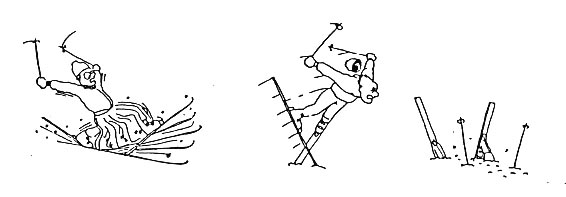
Even the ropetow brings disaster.
I fall down and wallow in the snow, pinned in place by my huge skis, and the
embarrassing dogpile begins, as skiers coming up the ropetow are, like dominoes
in a line, toppled by my sprawling carcass. Gosh, it sure is fun to
ski.
With time, some things improve. After
the first humorous (for onlookers) and terrifying (for me) trip down the crowded mountain,
my bindings are adjusted so I can bellyflop more safely. And I develop a
strategy of "leap and hit the ground rolling" to minimize ropetow
humiliation. But my skiing doesn't get much better so — wet and cold,
tired and discouraged — I retreat to the safety of the lodge.
How I Did
Learn to Ski ( Insight and Practice, Perseverance
and Flexibility )
The lodge break is wonderful, just what
I need for recovery. An hour later, after a nutritious lunch topped
off with delicious hot chocolate, I'm sitting near the fireplace in warm dry
clothes, feeling happy and adventurous again. A friend tells me
about another slope, one that can be reached by chairlift and is much less crowded, and I'm now feeling frisky and bold so I decide
to "go for it."
This time the ride up the mountain is exhilarating.
Instead of feeling the humiliation of causing a ropetow domino dogpile and being on the bottom, the lift carries me high above
the earth like a great soaring bird. Soon, while moving mainly across the hill (not mainly down it) with a rare feeling of control, I dare
to experiment — and the new experience inspires an insight! If I press
my ski edges against the snow a certain way, they "dig in."
This edging, combined with insights from other experiments — an "unweight and ski-swing" (a "jump a little so I can swing the skis around"
leg-ankle-foot movement) — produces a crude parallel turn that lets me zig-zag down the
slope in control, without runaway speed, and suddenly I can ski!
Continuing practice now brings rapidly
improving skill, and by day's end I'm feeling great. I still fall down
occasionally, but not often, and I'm learning from everything that happens,
both good and bad. And I have the confident hope that even better downhill
runs await me in the future. Skiing has become fun!
This experience illustrates two useful principles for learning:
1) Insight and Quality Practice: I learned how to ski by doing it correctly, with high-quality practice, not by making mistakes. There was no amazing improvement until I discovered the "unweight, ski-swing, ski-edge" tools for turning. This insight made my practicing effective so I could quickly develop improved skill: insight --> quality practice --> skill. Working as cooperative partners, insight and practice are a great team. Together, they're much better than either by itself.
2) Perseverance and Flexibility:
My morning ski runs weren't fun and I didn't learn much, but I kept trying
anyway, despite the risk of injury to body and pride. Eventually this
perseverance paid off. Because I refused to quit in response to frustrating
morning failures, I experienced the great joys of afternoon success.
/ But if I had continued practicing the old techniques over and
over, I never would have learned the new way to turn. Perseverance led
to opportunities for additional experience, but flexibility allowed the new
experience that produced insight and then improvement.
Perseverance and flexibility are contrasting
virtues, a complementary pair whose optimal balancing depends on aware understanding
(of yourself and your situation) and wise decisions. In each situation
you can ask, "Do I want to continue in the same direction or change course?"
Sometimes tenacious hard work is needed, and perseverance is rewarded.
Or it may be wise to be flexible, to recognize that what you've been doing
may not be the best approach and it's time to try something new.
Steps and Leaps
In many areas of life, much
of your improvement will come one step at a time. Each step you take
will prepare you for the next step as you make slow, steady progress.
But you can also travel in leaps. This is possible because many skills
are interdependent, which is bad news (if you haven't yet mastered an important
tool, everything you do suffers from this weakness) and good news (because
key insights can let you make rapid progress, as in my skiing experience).
If you consistently learn from experience
by searching for insight, your steps and leaps will soon produce a wonderful
transformation. You will find, increasingly often, that challenges
which earlier seemed impossible are becoming things you can now do with
ease.
The Joy of Thinking — it's
fun!
Personal goals for learning can include improving skills (like welding or thinking) and exploring ideas.
One powerful
motivating force is a curiosity about "how things work." We
like to solve mysteries. The joyful appreciation of a challenging
mystery and a clever solution is expressed in the following excerpts
from letters between two scientists who were intimately involved in the development
of quantum mechanics: Max Planck (who in 1900 opened the quantum era with
his mathematical description of blackbody radiation) and Erwin Schrödinger
(who in 1926 wrote and solved a "wave equation" to explain quantum
phenomena). Planck, writing to Schrödinger, says "I am reading your
paper in the way a curious child eagerly listens to the solution of a
riddle
with which he has struggled for a long time, and I rejoice over the beauties
that my eye discovers." Schrödinger replies by agreeing that "everything
resolves itself with unbelievable simplicity and unbelievable beauty,
everything
turns out exactly as one would wish, in a perfectly straightforward manner,
all by itself and without forcing." They struggled with a problem,
solved it, and were thrilled. It's fun to think and learn! / You can learn more about how
Planck and Schrodinger (plus Einstein & others) solved the mystery by learning to see our world from the fascinating perspective of micro-level quantum physics, where particles are waves, and waves are
particles.
You may not discover a basic principle of nature, like solving the mystery of quantum mechanics, but you can have your own "aha" moments when an idea (or a connection between previously independent ideas) suddenly becomes clear, when you find your own personal insights and you experience the joy of thinking-and-learning.
Forward-Looking Motivation
An attitude of intentional learning — of investing
extra mental effort, beyond what is required just to complete a task, with
the intention of achieving personal goals for learning — is a
problem solving approach to self-education because the goal is to transform
a current state of personal knowledge (including ideas and skills) into an
improved future state.
Effective intentional learning combines
an introspective access to the current state of one's own knowledge, the foresight
to envision a potentially useful state of improved knowledge that does not
exist now, a decision that this goal-state is desirable and is worth pursuing,
a plan for transforming the current state into the desired goal-state, and
a motivated willingness to invest the time and effort required to reach this
goal.
The use of knowledge can
be viewed from two perspectives: backward-reaching and forward-looking.
You can reach backward in time, to use now what you have learned in
the past. Or you can try to learn from current experience, motivated
by your forward-looking expectations that this knowledge will be useful in
the future.
In a forward-looking situation a learner
is anticipating the future use of an idea in a context that may be similar
(for basic application) or different (for application
involving transfer). When this occurs
an idea becomes linked, in the mind of a learner, to several contexts — including
situations imagined in the future — thus producing a bridge between now and
the future. This mental bridge can lead to improved retention (so knowledge is preserved) and application/transfer (so knowledge is more likely to
be used).
Intentional learning and
forward-looking application are closely related, and both strategies are activated
when a student wisely asks, "What can I learn now that will help me in
the future?"
So far,
our focus has been on the learner. But what about teachers? The following
section examines an important function of a teacher: to motivate students
so they will want to learn.
Motivational
Teamwork in Education (with students-and-teachers operating as a team)
What ideas and skills should students
learn?
Are the educational goals of a teacher (or a system of schools) worthy of the time invested by students and teachers?
Do students understand the goals, and want to achieve them? Of course,
goal-directed teaching is easier if students
are motivated by their own desires for goal-directed
learning, and if there is agreement about goals.
When worthy
goals are highly valued by students, the school experience is transformed
from a shallow game (of doing what the teacher wants, with the short-term
goal of avoiding trouble) into an exciting quest for knowledge in which the
ultimate goal is a better life. Instead of doing only what is required
to complete schoolwork tasks, students will invest extra mental effort
with
the intention of pursuing their own goals for learning. Why? Because
they are motivated by a forward-looking expectation that what they are learning
will be personally useful in the future, that it will improve their lives.
They will wisely ask, "What can I learn now that will help me in the
future?"
When teachers and students
share the same goals, education becomes a teamwork effort with an "us"
feeling. When students are highly motivated to learn, simply calling
attention to a learning opportunity is sufficient.
Why should students want to learn? Basically, students are motivated by activities they think are fun and/or useful. Of course, fun and utility, like beauty, are in the mind of a beholder. But in many situations,
persuasion by a teacher is helpful, to show students why they should want to learn
what is being taught.
Of course, this persuasion will be easier and more effective if, when teachers are designing their instruction, they try to search for goals and activities that connect with what students
want to learn. During activities designed to teach thinking skills,
if students are studying topics that connect with their personal interests,
they will think more willingly and participate more enthusiastically.
They will have fun, and they'll be preparing for the future. How?
If students are studying topics they find interesting and relevant, and there
is a forward-looking expectation that what they are learning in school will
be personally useful in the future, they will want to learn so they can improve
their own lives. A teacher can promote this attitude of internally motivated
learning by explaining how students can use "school knowledge" in
their lives outside the classroom.
For example, students will be more motivated
to improve their scientific thinking skills when they realize — because a
teacher calls it to their attention — that similar problem-solving methods
are used in science and in other areas of life,
in the design of familiar products, theories,
and strategies. The similarities between design and science, and the
advantages of a "design before science" approach, which lets students
begin with familiar skills so they can build on the foundation of what they
already know, are discussed in An
Introduction to Design.
a summary: An essential function of education, and a satisfying aspect of teaching, is to motivate students so they want to learn. Motivation can be inherent (to enjoy an interesting activity), external (to perform well on an exam), personal (to improve the long-term quality of life), and interpersonal (to impress fellow students or a teacher). Hopefully, students will discover that thinking is fun, and they will want to do it more often and more skillfully!
motivation in
home schools: In a traditional classroom, in a public
or private school, a teacher tries to produce a "community"
feeling with cooperative teamwork and a sharing of goals, as discussed
above. In home schooling, which offers the possibility of individually
customized educational goals and personalized instruction, it should be
easier to agree on goals and to enjoy the benefits that result from a
close teamwork between teacher and student.
External
sources of motivation, such as exams, which are a common part of the instructional
process in traditional settings, often serve valuable functions. But
personal motivations also offer benefits, as explained below.
Motivations:
External and Personal
An interesting question is,
"What are the relative effects of motivations that are external (focused
on getting rewards offered by others, with judgment by others) and personal
(focused on rewards that are internal, within a person, as judged by the person)?"
This is discussed in Dimensions of Thinking (Marzano, et al, 1988,
page 25):
Creative individuals look inwardly to themselves rather than outwardly to their peers to judge the validity of their work. ... Closely related to the locus of evaluation is the question of motivation. Perkins (1985) asserts that creativity involves intrinsic more than extrinsic motivation. Intrinsic motivation is manifested in many ways: avowed dedication, long hours, concern with craft, involvement with ideas, and most straightforwardly, resistance to distraction by extrinsic rewards such as higher income for a less creative kind of work. In fact, considerable evidence indicates that strong extrinsic motivation undermines intrinsic motivation (Amabile, 1983). Of course, this evidence is consistent with the discussion of attitudes about self in Chapter 2. Encouraging students to emphasize their success at tasks can eventually undermine self-esteem. Rather, we should help students to work more from their own internal locus of evaluation and encourage them to engage in tasks because of what they might learn or discover.
comments: Eventually, I'll find more information about this idea. For example, I want to know what the authors mean when they say that "encouraging students to emphasize their success at tasks can eventually undermine self-esteem." I'm sure there is a balance here, with some types of "encouragement to success" (done in some ways, in some amounts) producing beneficial effects, while other approaches to externally defined success, especially if carried to extremes, are detrimental. Also, can we make a sharp distinction between different motivations? Personal motivations, as discussed throughout this page, may include the hope of external rewards (employment as a welder,...) or interpersonal rewards (praise for skiing skill,...) in the future, with delayed (but externally oriented) gratification, so distinctions between types of rewards (inherent, external, personal, interpersonal) are not always distinct or clear. But it can still be useful to think about different aspects of educational motivation, about why we want to learn.
What's Next? — Motivations for Learning and Strategies for Learning are the foundations of education. But this
page is just a beginning, an introduction to a wide variety of fascinating
ideas. An exploration of these ideas continues in
the related pages below.
REFERENCES
Carl Bereiter & Marlene Scardamalia, 1989.
"Intentional Learning as a Goal of Instruction," in Knowing,
Learning, and Instruction, edited by L. Resnick. Lawrence Erlbaum
Associates: Hillsdale, New Jersey.
David Perkins & Gavriel Salomon, 1988.
"Teaching for Transfer," Educational Leadership 46, 22-32.
David Perkins, 1992. Smart Schools:
From Training Memories to Educating Minds. Free Press (Macmillan):
New York.
IDEAS — Bereiter & Scardamalia (1988) describe a principle of intentional learning; Perkins & Salomon (1988) suggest that the application and transfer of knowledge can be analyzed along two dimensions (backward-reaching or forward-looking, and high road or low road); and Perkins (1992) introduces a simple theory that "people learn much of what they have a reasonable opportunity and motivation to learn" and explains its implications for instruction.
CARTOONS — Frank Clark, 1982 — inspired by reading about
my skiing misadventures, he drew "a mighty bellyflop in icy snow." He also made Power Tools for Effective Learning & Cooperative Juggling and is now Creative Director of Square Tomato Advertising in Seattle.